
Stoneware is a type of pottery made from clay fired until it forms a hard, dense ceramic body. Stoneware is usually fired to about 2,010–2,370°F (1,100–1,300°C). At that heat the clay partly turns glassy, so the finished piece absorbs very little water, typically less than 1%. It is typically opaque and commonly used for mugs, bowls, plates and serving pieces. The clay recipe and firing process give stoneware its character, while glaze adds a different surface, color or finish.
All Altar Ceramics pottery is made from stoneware. Here is how it compares with porcelain and earthenware, what the terminology means, and what to look for when choosing a piece for your home.
Stoneware vs Earthenware vs Porcelain
Earthenware, stoneware and porcelain are three familiar types of pottery. Their differences come from both the clay body—the material used to make the piece—and how it is fired.
| Feature | Earthenware | Stoneware | Porcelain |
|---|---|---|---|
| Fired clay body | Generally porous; commonly glazed for tableware | Dense, with water absorption that varies by recipe and firing | Typically very dense, with low water absorption when properly fired |
| Appearance beneath the glaze | Can be red, buff or white | Can be white, cream, gray, brown or speckled | Usually white; can be translucent when thin |
| Surface and form | Ranges from rustic terracotta to smooth, decorated dishes | Can be smooth or textured, with fine or substantial forms | Often fine and smooth, but also used for thicker pieces |
| Common uses | Tableware, decorative pottery and plant pots | Mugs, bowls, plates, serving pieces and decorative pottery | Tableware, teacups, decorative pieces and sculpture |
These are general characteristics, rather than a quality ranking. All three can become carefully made, useful objects. Glaze can also hide much of the clay’s natural appearance, so a finished piece may look quite different from the material underneath.
What Is Stoneware Made Of?
Stoneware is made from a clay body, which may combine several clays and other minerals. Recipes vary: some include feldspar to help the body mature during firing, silica, or particles of previously fired clay called grog to change its working properties and texture.
There is no single stoneware recipe. The blend affects how the clay handles in the studio and how it looks after firing. That is why one stoneware mug can have a smooth, pale base while another has a darker, textured one.
How Does Clay Become Stoneware?
The clay is shaped, dried and fired in a kiln. During firing, the body becomes denser as its minerals change and a glassy phase develops within it. Potters call this process vitrification. It helps explain why a finished piece behaves differently from the soft clay it began as.
The appropriate firing depends on the clay recipe. Stoneware and porcelain firing ranges can overlap, so kiln temperature alone does not identify the material.
Glaze is a separate part of the piece: it is the glassy coating applied to its surface and fused there during firing. A glossy, matte or painted finish does not, by itself, tell you whether the clay beneath it is stoneware, earthenware or porcelain.
Stoneware vs Porcelain: Which Should You Choose?
Stoneware and porcelain can both make practical everyday tableware. Porcelain bodies typically use white-firing clays such as kaolin and can become translucent in thin sections. Stoneware offers a broad range of clay colors and textures, including white bodies as well as darker or speckled ones.
For a mug or bowl you will use regularly, compare the actual pieces:
- Look: consider the exposed clay, glaze and decoration. White pottery is not necessarily porcelain, and stoneware does not have to look rustic.
- Feel: check the weight, handle and rim. Size and wall thickness affect how a piece feels; the material name alone cannot tell you its weight.
- Function: choose a capacity and shape that suit your routine, then follow the maker’s instructions for that particular piece.
Neither material name guarantees that a piece will resist every chip or knock. Construction, firing and everyday handling all matter.
Pottery vs Ceramics: What Is the Difference?
Ceramics is the broader category; pottery is part of it. Pottery generally refers to objects made from clay and fired, including mugs, bowls, plates and vases. The wider ceramics category also includes tiles, bricks and technical materials used outside the home.
Stoneware, earthenware and porcelain all fall within pottery and ceramics. A stoneware mug is therefore both a piece of pottery and a ceramic object.
If a product listing simply says “ceramic,” that does not identify its specific clay body. Look for more detail from the maker rather than assuming the piece is earthenware.
How Can You Tell If a Piece Is Stoneware?
Start with the product description or information from the maker. A material label, studio record or identifiable maker’s mark can help you learn what clay was used.
An unglazed area on the base may show the clay’s color and texture, but appearance is only a clue. White stoneware can resemble porcelain, and glaze can cover the body almost completely. Weight is not a reliable identifier either.
If the material matters to your purchase, ask the maker which clay body they use. For an older or secondhand piece, its material may remain uncertain without reliable documentation.
Stoneware at Altar Ceramics
Every Altar mug, cup and pourer is handmade from stoneware by Karina Subijana in Nevada City, California. Each piece moves through several stages: preparing and shaping the clay, drying, a first bisque firing, decorating and glazing, then a glaze firing and finishing touches.
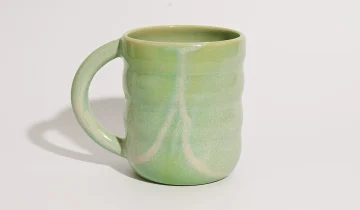
You can see the material across different forms in the collection, from the rounded shape of the Medium Bubble Mug to the taller profile of the Tall Oil Pourer. Learn more about Karina and Altar Ceramics.
For washing, microwave use and other handling instructions, visit the pottery care guide.
More Questions About Stoneware
Can stoneware be white?
Yes. Stoneware includes white and cream clay bodies as well as gray, brown and other colors. The visible glaze may be a completely different color from the clay beneath it.
Does stoneware mean handmade?
No. Stoneware describes a type of fired clay body. It can be made by an individual potter or produced in a factory. Check the maker’s description if you are looking for handmade work.
Explore Altar's Stoneware
Browse all of Altar’s mugs and cups for coffee and tea, or explore pourers for the kitchen and table to find a piece for your everyday routine.
Further reading: Digitalfire’s stoneware reference, its explanation of vitrification, and the Victoria and Albert Museum’s ceramics glossary.




 No products in the cart.